Designing Dry Erase Card Games
4/10/20267 min read
I've always been a huge fan of approaching game design from within a specific set of constraints. Questions like "what can I make with only x,y,z" tend to lead down some pretty interesting rabbit holes. Doom Machine, for example, initially came about from trying to figure out how much game I could smash into a mint tin. I've found this approach works super well for me, since I make smaller games.
Even before tariffs sent board game manufacturing into a tailspin, I was spending a lot of time thinking about how to make games without the high overhead. This led me deeper into the realm of roll-and-write games, which I have a great fondness for. Being able to print something out, grab some dice and tokens, and play a game feels very punk af. Inspired, I started designing a handful of games with print and playability as the core focus, which led me to trying out some weird things.
Anytime I make a physical game prototype with cards in it, I'll usually grab some of those plasticky Magic the Gathering card protector sleeves, jam a poker card in there, and slip the printed out front and back card layouts on either side. This makes them easy to shuffle, and swapping out art to update the prototypes is pretty simple. Inevitably, I began wondering if there was a way to incorporate them more intentionally into some of my designs.
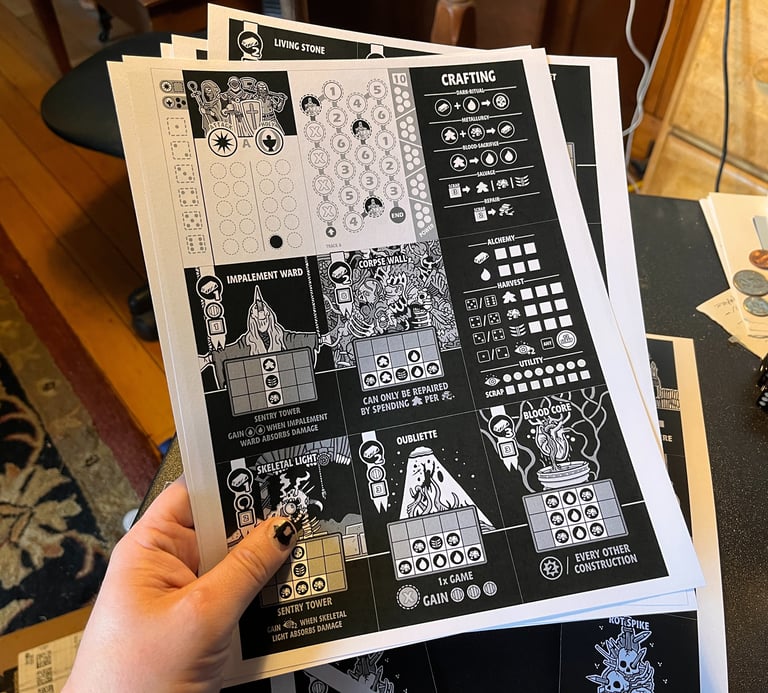
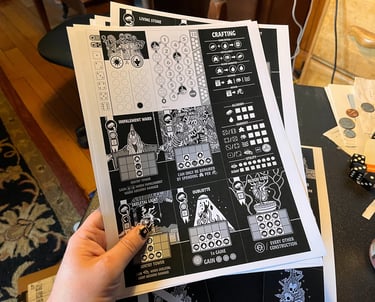
Drawing on surfaces is one of my favorite aspects of modern roll and writes, and I love it when games incorporate using dry erase on small player boards. Since the surface of card protectors is dry eraseable, I decided to start tinkering with making small card-based roll and write prototypes where writing on the cards is a core mechanic. As you might imagine, this pairs exceptionally well with print and play.
Enter: Morbid Fortress
Morbid Fortress is a solo crafting and tableau builder roll and write where the cards are the board, essentially. This near-finished prototype was one of the few I recovered when my hard drive died and annihilated almost all of my old game layout files. I'm glad it didn't get nuked, because I really love how it came out and I'm stoked to share it with people this year.
The idea, once again, came about from setting design constraints. I wanted to limit the core game to 18 cards, use at least some dice (because I'm a slut for dice), and make dry erase a key mechanic by utilizing protective card sleeves. That's not a lot to work with, but it nudged me into some clever corners.
Vibe Check
Thematically, Morbid Fortress' derpy flavor text does most of the heavy lifting: "That Morbid Fortress isn’t going to finish building itself! Flex your necromantic might and craft the darkest, most grisliest, gnarliest stronghold of pure unholiness. But wait, what’s that on the horizon? CRUSADERS! Drat…that complicates things a bit."
That's it. That's the setup. In essence, you are a necromancer trying to build a badass fortress while meddlesome, murderous do-gooders keep trying to thwart your plans. You have a finite number of turns to gather materials, craft resources, and build important structures for reinforcing your stronghold -- all while fending off attacks, making repairs, and hunkering down for the final push at the end of the game.
I do all of the artwork and graphic design for my games, and I love a good minimalist project that only requires me to design 18 cards. Love that for me, so much. I went with a simple black, white, and grey color palette, and settled on a less serious tone than some of my other recent games. It's still dark, to be sure, but the creepy is softened with a kiss of camp. As a treat.
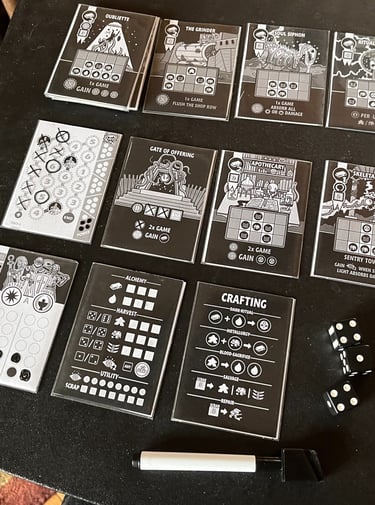
Buildings: Going Maximal with Minimal
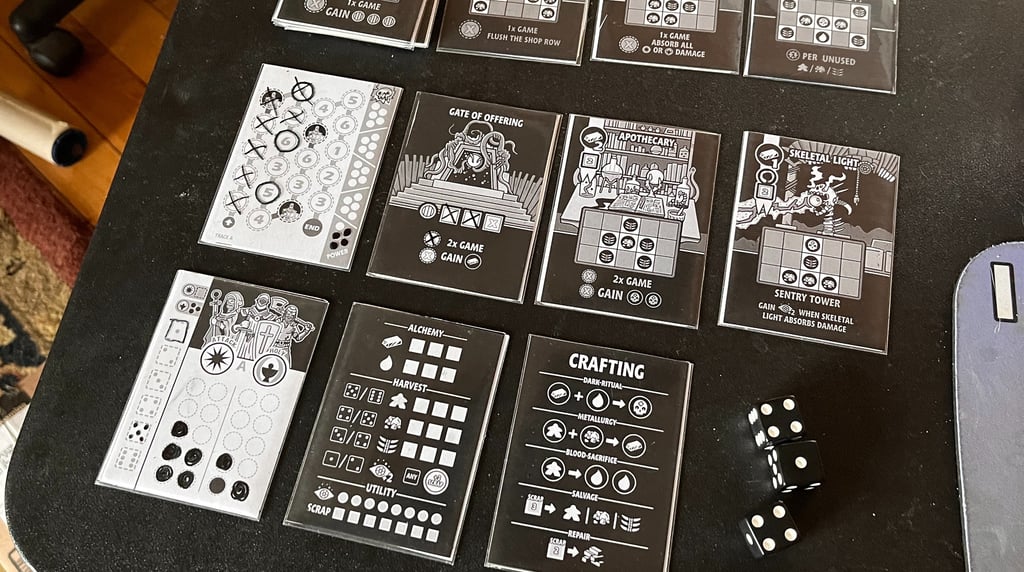
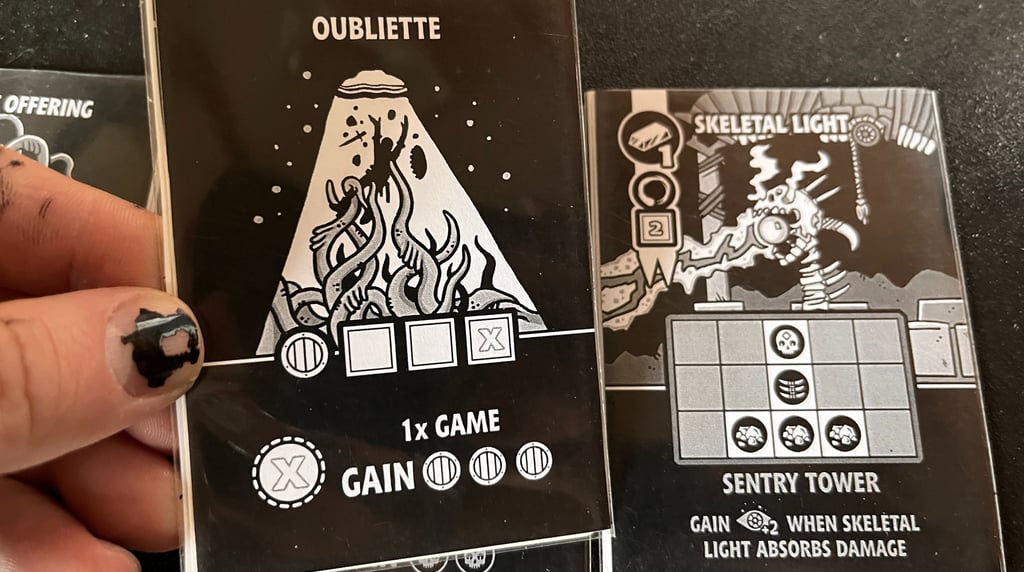
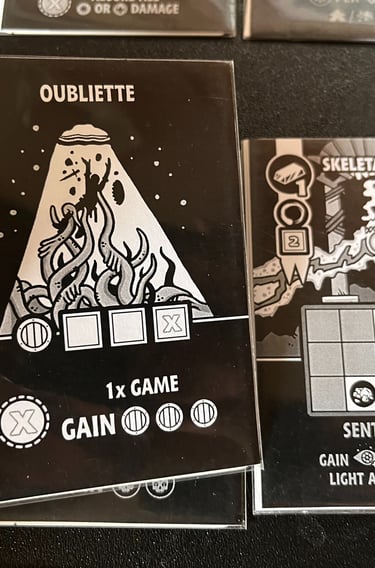
So yeah...18 cards. Some of them are used to track resources and progress through the game, while others represent structures you must build to mount a defense and gain abilities to increase your changes of survival. Each building card is double-sided. One side has its purchase cost, shows the ability you gain from building it, and has a grid layout showing the resource recipe you need to complete it. The other "built" side has icons that affect incoming damage, abilities or scoring synergies, and boxes that represent how much damage it can absorb when the crusaders attack.
Over the course of multiple rounds, you'll purchase structures and work to complete them by spending and crossing out resources on the cards with the dry erase marker as you go. The autistic completionist in me finds this aspect of the gameplay particularly satisfying. When all of the necessary resources for a building are crossed out, you flip the card over and get to use it in your fortress. The base game has 14 buildings, but you'll rarely get to build more than 6-7 in a single game, so there's a lot of variability there. I'm also working on an 18 card expansion that'll have more buildings and some special cards that modify the game in different ways.
Dice Systems - Crafting and Crusaders
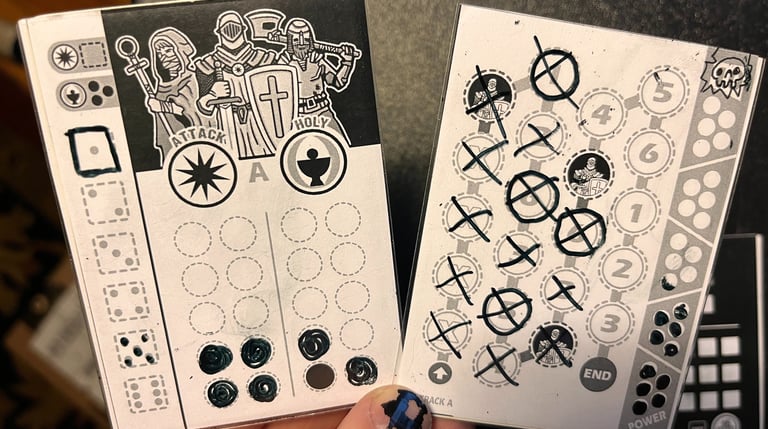
Another aspect of the design I'm fond of is how dice rolls tie into multiple systems. At the start of the game you'll roll two dice to determine which roll numbers trigger an increase in the crusaders attack strength. This naturally grows over time, but can be mitigated by certain buildings and abilities.
From there, each time you roll your three dice at the start of a given round, a few things happen.
First, you check to see if any of the rolls affect the crusader strength and increase it when they do.
Then, if you are on a crusader rally point circle on the progress track, you'll draw circles around the matching rolled number spaces ahead of you on the next section of the track to indicate which rounds you'll get attacked.
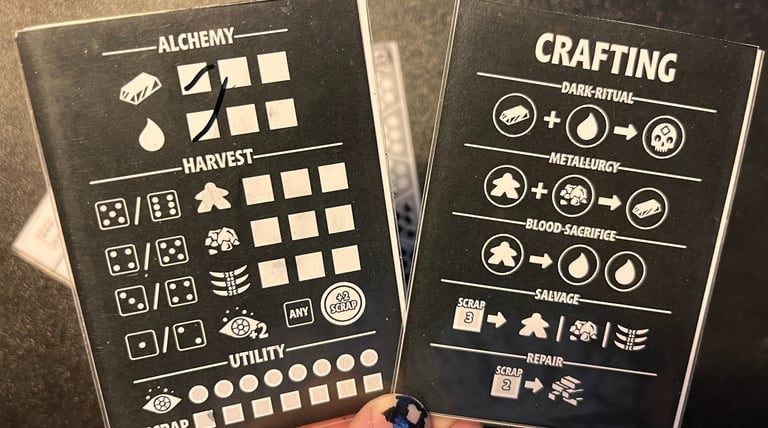
Then you'll use the same dice roll results to determine what resource you've gathered -- and of course there's some wiggle room there in terms of resource choices, using reserved resources to modify dice, etc.
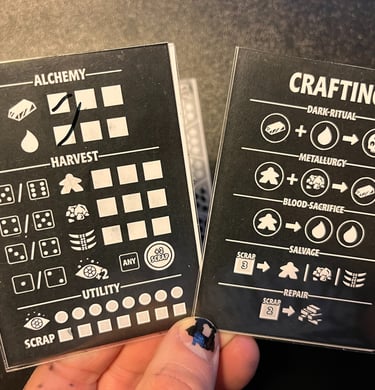
From there, you spend the rest of your turn doing some combination of crafting, purchasing structure blueprints, and chipping away at building your fortress between attacks. It's a thinky puzzle without being too brain burny.
Rising Tension
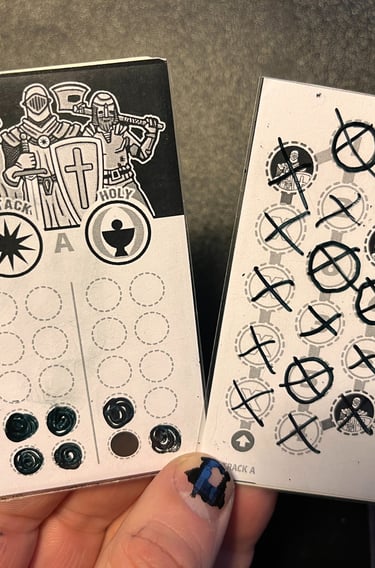
There's only so much you can do in a given round, so managing resources and working hard to get those buildings up is super important during the quieter turns. Crusader attacks can be brutal if you don't have enough buildings to absorb the damage. When you get attacked, you'll face incoming damage from the combined strength of the crusader attack and holy tracks, which grow in power as the game progresses. Certain buildings will let you wipe dots off of either side, but in most cases you're going to have to absorb damage of some sort.
Completed buildings have boxes for this -- you can choose to mark off one box per damage to mitigate it, but once a building's boxes are full, it can't block any more damage until you spend resources on future rounds to repair it. Any unblocked damage gets added to the crusaders' overall power track. When that maxes out, it's immediate game over. However, if you do survive until the final onslaught, you have to make sure that your score (which is a combination of blockable damage capacity on finished structures and victory points from card abilities) is strong enough to beat the crusader score.
A good solo game needs to be tough (IMHO). If you enjoyed Doom Machine, I think you'll vibe with this one.
Morbid Fortress has a lot of replayability for just 18 cards. There's something so satisfying about designing a play space that can be shuffled, reorganized, marked, arranged, flipped, and interchanged each time you play to freshen the experience. The 18 card format can be so tight to work with, but I love the way it forces me to think outside of my usual mental boxes.
Playtesting and Future Plans
The core game feels tight, and I've put it through a lot of paces...but I am looking for playtesters who are interested in kicking the tires with a print and play build. The game is 99 percent finished art wise -- I just need some feedback on the play experience.
If you're interested in becoming a playtester, shoot me an e-mail at: thenathanmeunier at gmail dot com
Regarding release plans, I'm hoping to use Morbid Fortress as an experiment. I'll be releasing a print-and-play version through my website AND I hope to create a physical version with The Game Crafter, where I get all of my physical games manufactured. They have a coating that makes cards dry eraseable, and I'm exploring some cool packaging options for a physical release. Expect a Crowd Sale for that one, too.
Anyhoo, that's it for now. Thanks for reading! Don't forget to follow me on the Insta-ma-grams here for updates.